









From October 12 to 29, 2025, the Embodied Intelligence Training Camp “Leyun Embodied Intelligence · SparkEdu · Shanghai Jiao Tong University Station” concluded successfully. Jointly hosted by the SJTU Paris Elite Institute of Technology, the Shanghai Jiao Tong University Student Innovation Center, and the DAMO Developer Matrix, and co-organized by the Shanghai Jiao Tong University Artificial Intelligence Innovation Association.
Leveraging the zero-barrier, one-stop robotics development platform—Leyun Embodied Intelligence Platform—developed by Alibaba DAMO Academy, the camp featured a unique blend of “hands-on experiments + online exploration.” Its goal was to empower students to complete end-to-end learning and practice—from AI model training to physical world interaction—using just “a computer, a low-cost robotic arm, and a stable internet connection” during their free time.
The camp attracted enthusiastic applications from over 100 undergraduate, master's, and doctoral students across the SPEIT, School of Mechanical Engineering, School of Computer Science, and School of Artificial Intelligence. After comprehensive evaluation of academic backgrounds, research interests, and grade-level diversity, organizers selected 50 students to form 14 teams for a two-week immersive exploration and hands-on practice in embodied intelligence.

At the opening ceremony, three technical experts from DAMO delivered lectures. They provided accessible insights into the evolution and latest advancements of large models, helping students grasp the foundational logic of AI. Subsequently, the experts detailed the architecture and capabilities of the Leyun Embodied Intelligence Development Platform, demonstrated cloud-collaborative access pathways, and showcased the complete workflow from data collection to skill deployment through hands-on demonstrations. The organizers also established a dedicated development platform at SPEIT Student Innovation Center, providing participants with practical environments and technical support.
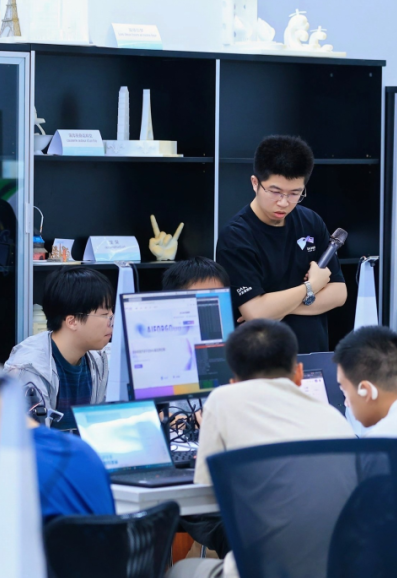
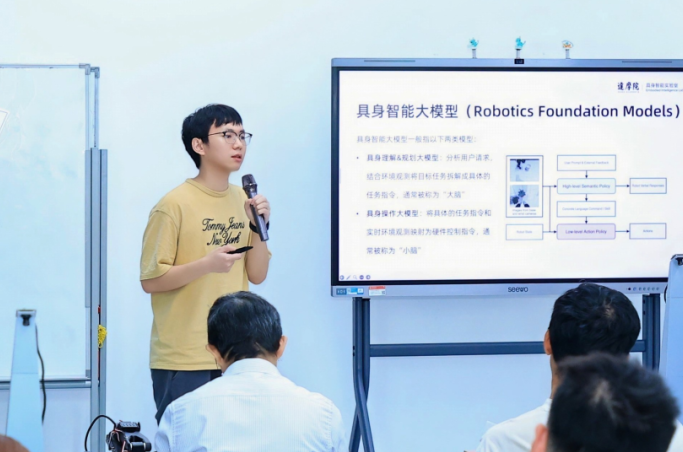
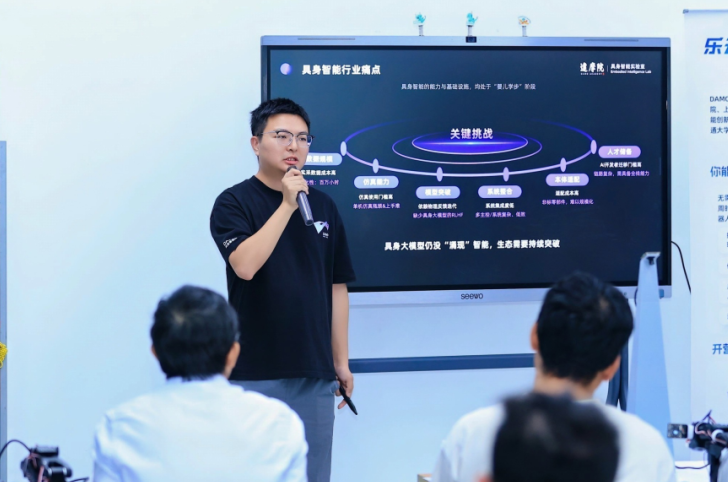
During the two-week project phase, leveraging the platform's cloud-edge collaboration architecture and real-time community Q&A, participants systematically completed end-to-end experiments—from data collection and model fine-tuning to skill deployment and real-device validation—under the guidance of DAMO technical experts and teaching assistants. Fourteen teams ultimately developed over a dozen projects based on embodied intelligence large models.
During the evaluation phase, experts conducted comprehensive assessments based on core metrics such as “skill success rate” and “interference resistance.” Projects that stood out included: “Simulated Robotic Arm for Rescue in Earthquake Disaster Relief” (Zhou Junyu, Gui Tian'ai, Li Nan), “Green Block Identification and Sorting Robot Arm” (Wei Zhendong, Zhang Jiarong, He Junhao), and “Desktop Cleaning Robot Arm” (Zhu Guangpu, Li Mingzhu, Gui Xiangyu) stood out, earning the “Outstanding Team Award.” These achievements fully demonstrate the solid engineering skills, agile learning abilities, and exceptional innovation capabilities of SJTU students.
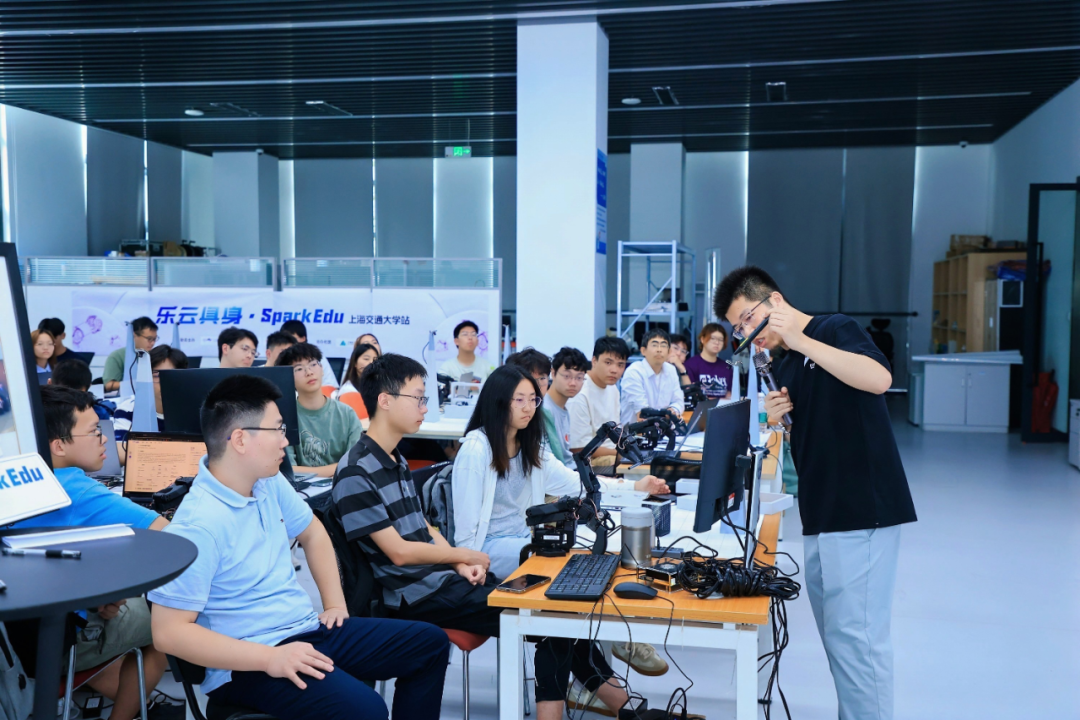
The successful execution of this training camp represents a significant collaborative effort between SPEIT and the University Student Innovation Center to advance the integration of AI and engineering education. Its innovative “lightweight launch, deep practice” model not only aligns with students' needs to balance academics and scientific innovation but also effectively reduces the time and space costs associated with traditional engineering practice education, significantly enhancing the activity's sustainability and promotional value.
Moving forward, SPEIT students will continue expanding resources, refining innovative projects like embodied intelligence, and building more accessible, flexible open platforms. This will empower peers to gain real-world experience, enhance capabilities, and pioneer new pathways for engineering-AI convergence.
The DAMO Developer Matrix, jointly launched by Alibaba DAMO Academy and the Internet Society of China, has been authorized by the International Telecommunication Union (ITU) as the Chinese community platform for its “AI for Good” initiative. This community focuses on cutting-edge AI directions including foundational models, scientific intelligence, and embodied intelligence, committed to driving technological innovation, connecting industrial applications, and fostering an open, shared innovation ecosystem that integrates industry and academia. It has attracted participation from 43 universities and 18 AI enterprises across 9 countries and regions.
As a key initiative of the DAMO Developer Matrix for educational scenarios, “Leyun Embodied·SparkEdu” is dedicated to “empowering every student interested in AI and robotics to bring AI to life.” Through its cloud-edge collaborative architecture, it lowers technical barriers, enabling learners to complete the full journey from cognition to creation.
Student Feedback
Gui Tian'ai, SPEIT
This activity provided me with a more intuitive understanding of how intelligent agents accomplish tasks through interaction with their environment. The platform provided by DAMO Academy is exceptionally well-designed, enabling the entire process to be completed step-by-step online in a clear and efficient manner. Our team's task involved programming a robotic arm to first remove an obstacle blocking the target object, then grasp the target and place it in a designated area—a design simulating the process of rescuing casualties during earthquake relief operations.
The final training results were excellent, with the robotic arm executing movements naturally and smoothly without any lag. This experience gave me firsthand insight into the potential of embodied intelligence in practical applications and deepened my understanding of the close interplay between algorithms, perception, and execution. This training camp was not only an engaging science outreach experience but also a significant introduction to embodied intelligence for me.
Li Mingzhu, School of Mechanical Engineering
The Embodied Intelligence Training Camp, jointly organized by DAMO Developer Matrix and Shanghai Jiao Tong University, delivered a hands-on technical journey packed with practical insights. I seamlessly navigated the entire workflow—from data processing and model training to real-device inference.
Our team focused on practical desktop cleanup scenarios, designing a robotic arm solution specifically for grasping pen barrels and placing them into cylindrical pen holders, with an emphasis on the precision manipulation capabilities of the robotic arm. After fine-tuning the platform parameters, the GR00T model not only consistently completed pen barrel grasping and precise placement but also demonstrated tracking capability and robustness when encountering moving pen barrels in dynamic environments. This project provided me with a clearer understanding of LeroBot's three-stage training process and tangibly enhanced my practical application and problem-solving skills.
He Junhao, School of Artificial Intelligence
Our team completed the task of identifying and sorting green blocks, enabling the robotic arm to recognize objects and make decisions in complex environments. Through data collection and model training, I personally witnessed the entire process of transforming “data” into “intelligent behavior,” gaining a profound understanding of how precise data endows machines with the ability to see and coordinate their hands and minds. This experience not only familiarized me with embodied intelligence development workflows but also reinforced my conviction that this technical pathway—from perception to execution—is the cornerstone for future robotics integration into vast domains like industry and logistics.