








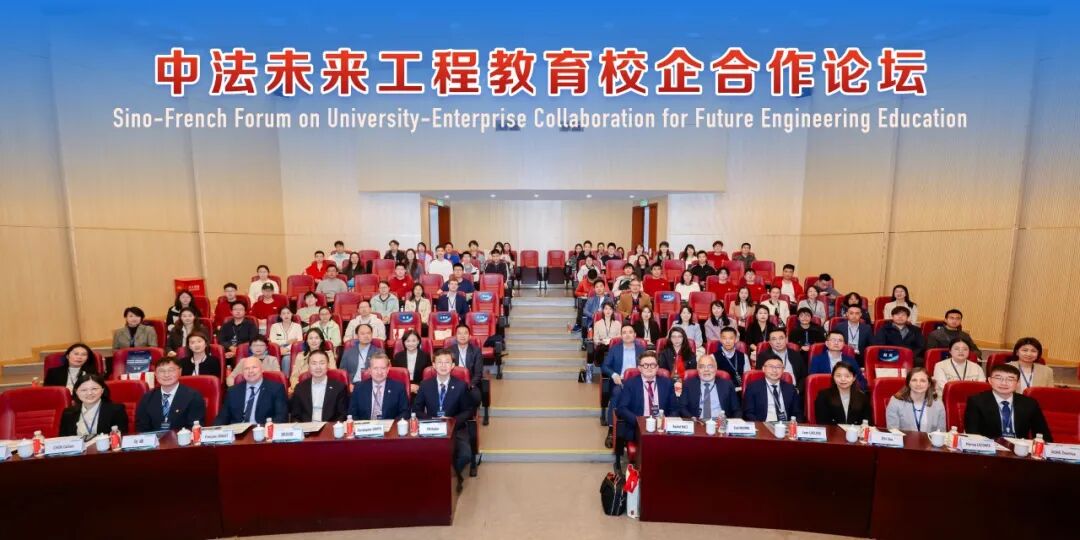
On the occasion of the 130th anniversary of Shanghai Jiao Tong University, and in order to further promote the deep integration of industry, academia, and research, on April 7, the “University-Enterprise Collaboration for the Cultivation of Elite Engineers; Sino-French Integration for a New Era of Education” was held at the Minhang Campus of Shanghai Jiao Tong University. The forum was hosted by the SJTU Paris Elite Institute of Technology. More than 30 pioneers in global engineering education and innovation leaders from enterprises—representing top universities, research institutes, and key industries such as aerospace, automotive electronics, semiconductors, and intelligent manufacturing from China and France—gathered to jointly outline a new blueprint for future engineering education.
1
Building Consensus: Opening a New Chapter in Engineering Education
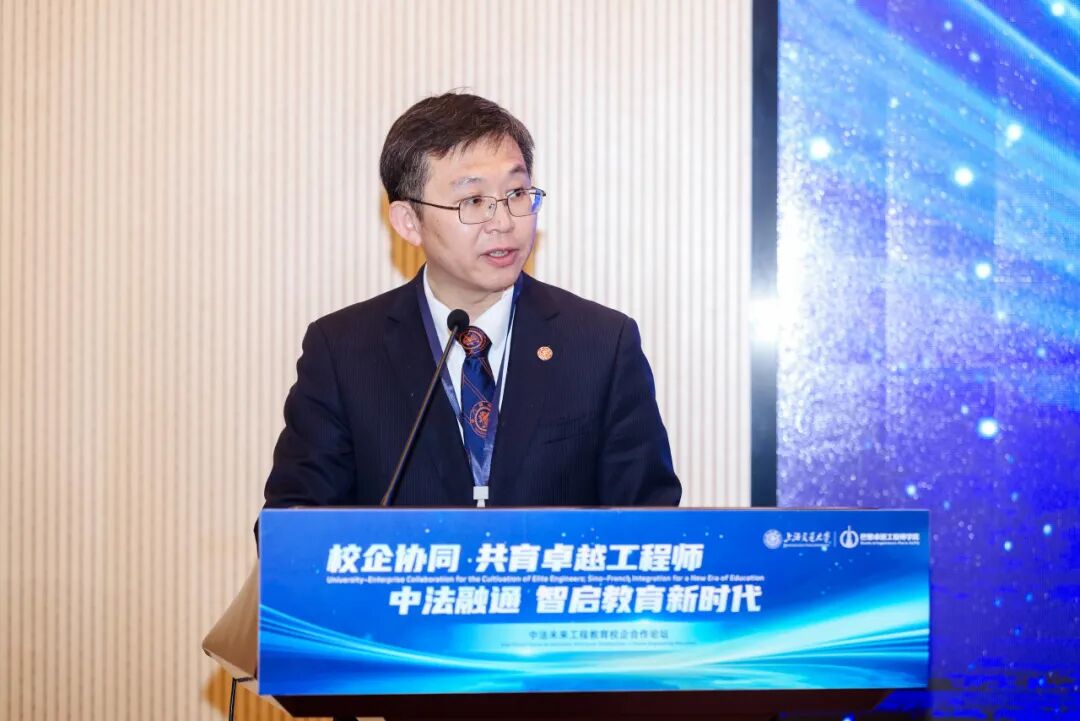
Yin Haitao, Director of the Office of International Cooperation and Exchange at Shanghai Jiao Tong University, pointed out in his speech that emerging technologies such as artificial intelligence are profoundly reshaping engineering practice and industrial forms, posing new challenges for engineering talent cultivation. Shanghai Jiao Tong University has always adhered to its tradition of emphasizing strong fundamentals, practical training, and innovation. As an important platform for Sino-French cooperative education, the SJTU Paris Elite Institute of Technology has developed distinctive pathways in university-enterprise collaboration and international integration. He emphasized the need to further promote the deep integration of the education chain, talent chain, and industrial chain, and to cultivate elite engineering talents with global vision, innovative capabilities, and the ability to solve complex problems.
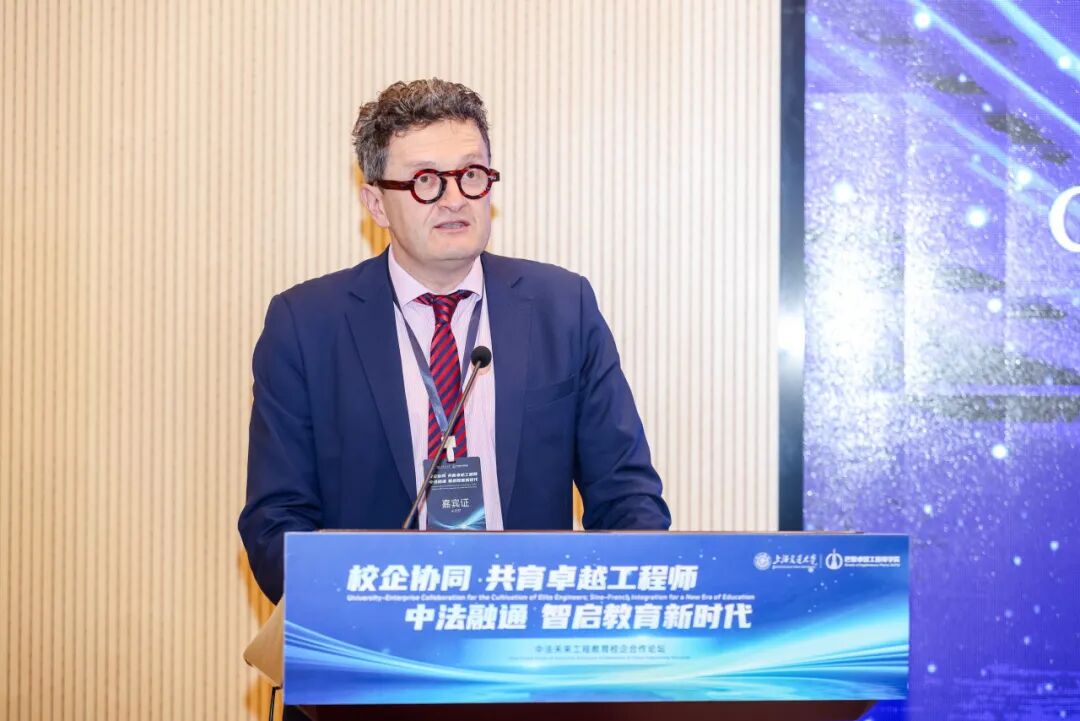
Rachid MALTI, Science and Technology Consul of the Consulate General of France in Shanghai, stated in his speech that China and France have a solid foundation for cooperation in engineering education, with complementary advantages in talent cultivation models and industrial practice. He expressed hope that this forum would serve as an opportunity to further deepen exchanges and cooperation between universities and enterprises in both countries, and jointly address the new challenges brought by global technological development.
2
Coordinated Efforts: Advancing University-Enterprise Collaboration
During the forum, the SJTU Paris Elite Institute of Technology signed a new round of strategic cooperation agreements with 12 leading enterprises.
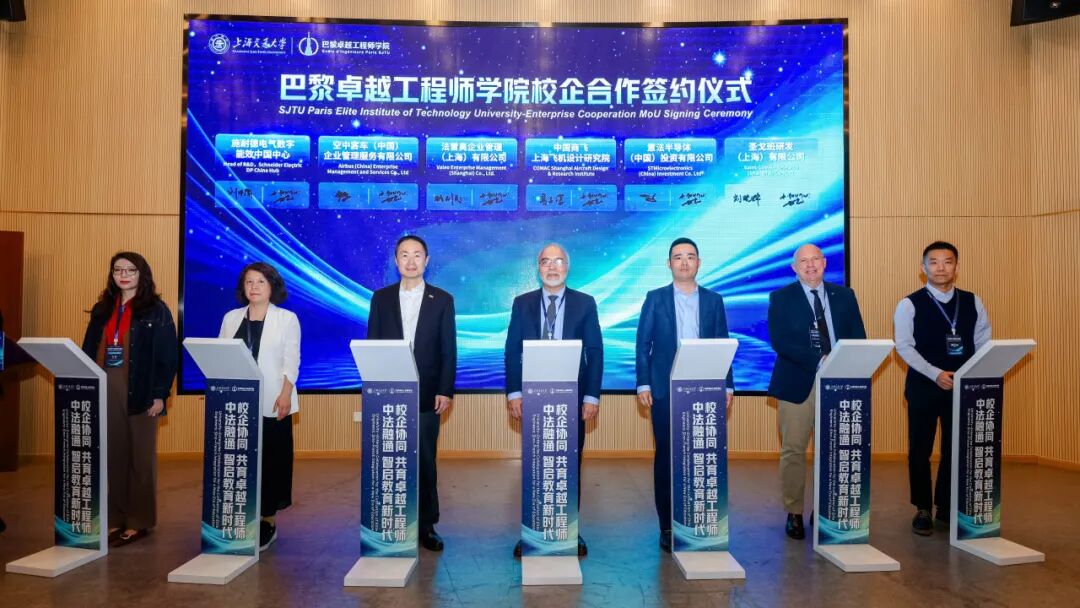

These agreements are closely aligned with national strategic needs and industrial development directions, covering joint laboratory construction, co-development of courses, internship and training bases, and targeted talent cultivation. They reflect the trend of enterprises deeply participating in the entire process of talent development and mark a new stage in the institute’s industry-education integrated training system.
3
Focusing on the Frontier: Exploring Innovative Talent Cultivation Pathways
In the keynote session, five experts from Sino-French academia and industry shared insights on engineering education reform and evolving industrial demands.
Léon LAULUSA, Executive President of ESCP Business School, analyzed trends in interdisciplinary talent cultivation from the perspective of integrating engineering and management education in Europe. Chen Cailian, Chinese Director of the SJTU Paris Elite Institute of Technology, introduced the institute’s exploration of integrating Sino-French curricula with industrial needs. Yi Zichun, Executive Deputy Director of the Electrical Control Integration Engineering Technology Institute of the Shanghai Aircraft Design and Research Institute, shared experiences from the development of large domestic aircraft and insights into cultivating high-end engineering talent. Gu Jianmin, Chief Technology Officer of Valeo China, provided an in-depth analysis of industrial transformation in the era of artificial intelligence and proposed pathways for the advancement of future engineers. Zhu Shu, Director of the Sino-French Cooperation Research Office at the Institute of Informatization, Center for International Economic and Technological Cooperation of the Ministry of Industry and Information Technology, systematically introduced talent cultivation and platform-building practices under the framework of Sino-French industrial collaboration from a policy perspective.
4
Diverse Dialogue: Jointly Shaping the Future of Engineering Education

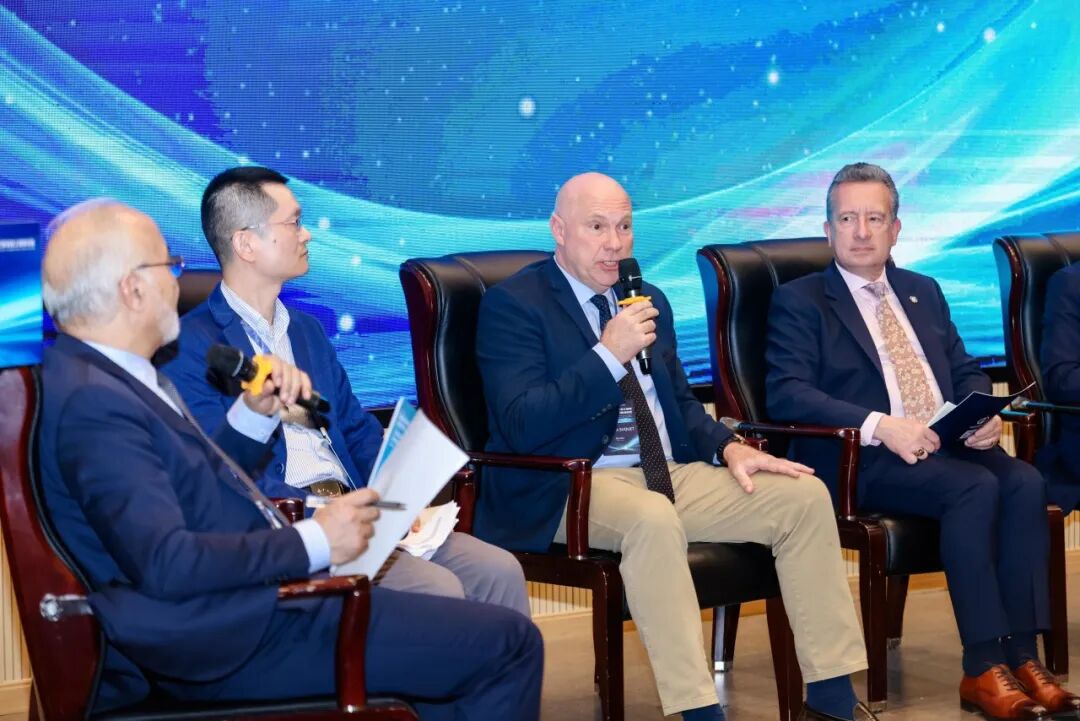
The roundtable forum was moderated by Zied MOUMNI, French Director of the SJTU Paris Elite Institute of Technology. Christophe CRIPPS, Vice President of École Polytechnique; Léon LAULUSA, Executive President of ESCP Business School; François SUQUET, Vice President of Human Resources and Corporate Social Responsibility for Asia-Pacific at STMicroelectronics; Yang Shouping, Senior Researcher at Midea Group Central Research Institute; Yu Li, R&D Engineer at the 711 Research Institute of China State Shipbuilding Corporation; and representatives from Dassault Systèmes participated in in-depth discussions on topics such as mechanisms for deep enterprise participation in talent cultivation, integration of Sino-French engineering education systems, and core competencies of engineers in the AI era.

This forum provided an important platform for deepening Sino-French cooperation in engineering education and promoting collaborative talent cultivation between universities and enterprises. In the closing session, the moderator Xiong Zhenhua conveyed the news of President Xi Jinping’s reply letter to all faculty and students of the four Jiaotong universities. In the future, the SJTU Paris Elite Institute of Technology will continue to expand its cooperation network, improve collaborative education mechanisms, and advance educational reform, striving to cultivate elite engineering talents with both a strong sense of national responsibility and global competence.