









On May 19, Shanghai Jiao Tong University held the technical acceptance review meeting for its “Double World-Class” construction project—the “Luo Shu” neutron small-angle scattering spectrometer—in Mianyang, Sichuan. Following an on-site inspection, project presentation, expert questioning, and discussion, the expert panel unanimously agreed that the “Luo Shu” spectrometer had passed the technical acceptance review. This marks an important breakthrough in China’s independently developed advanced neutron scattering experimental platform.

Academician Gong Shengkai of Beihang University served as chair of the expert panel, with Academician Tang Li of the China Academy of Engineering Physics (CAEP) and Academician Zhang Di of Shanghai Jiao Tong University serving as deputy chairs of the expert panel. The expert panel was composed of 16 experts from relevant domestic research institutes, universities, and industry organizations. Chen Jiangping, Director of the Office of Asset Management and Laboratory Affairs of SJTU; Hu Wei, Director of the Office of Key Initiatives; Lu Qi, Deputy Dean of the Institute for Science and Technology Development and Director of the Office of Academic Development and Research Outcomes; Sun Lizhen, Party Secretary of the School of Materials Science and Engineering; Liang Feng, Director of the Department of Science and Technology of CAEP; Zhang Jianhua, Director of the Second Department of CAEP; and other relevant leaders attended the acceptance review meeting. The meeting was hosted by Chen Jiangping.

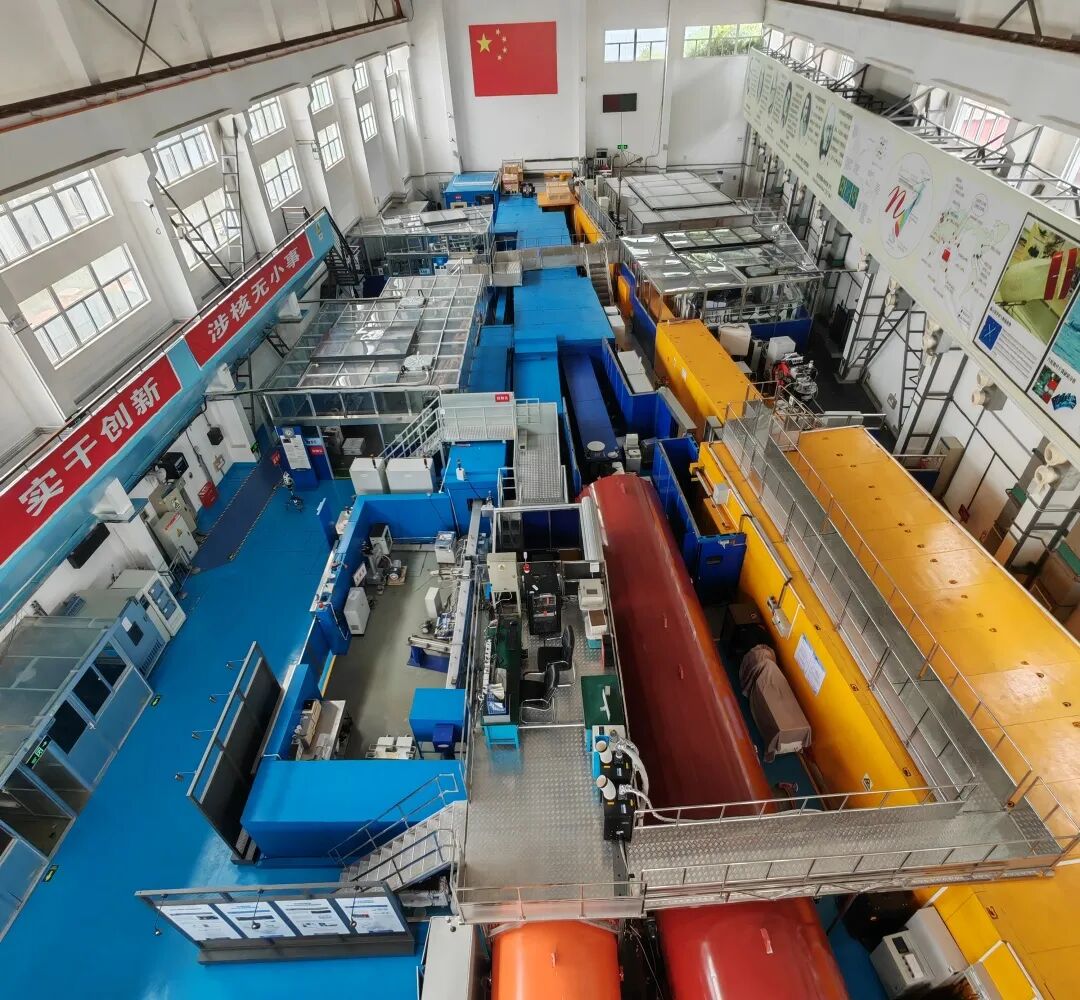
Before the meeting, the expert panel conducted an on-site inspection of the “Luo Shu” spectrometer facility. Professor Zhong Shengyi, chief scientist of the “Luo Shu” spectrometer project, Vice Dean of the SJTU Paris Elite Institute of Technology, and dual-appointed professor at the Paris Elite Institute of Technology and the School of Materials Science and Engineering of SJTU, introduced the features and construction progress of “Luo Shu”.
In her opening remarks at the acceptance review meeting, Director Hu Wei stated that SJTU has always remained committed to addressing major national strategic needs, continuously strengthening the layout of major scientific and technological infrastructure, and promoting the development of high-level research platforms. The completion of “Luo Shu” represents an important achievement in the university’s strategic layout in the field of neutron science, as well as an important practice through which both sides deepen collaborative innovation and jointly serve the country’s high-level scientific and technological self-reliance and self-strengthening.
In his remarks, Director Liang Feng reviewed the cooperation process in which both sides worked in joint efforts. He expressed the hope that the review experts would provide valuable suggestions while exercising technical oversight, so as to jointly develop neutron scattering technology and promote “Luo Shu” to play a greater role in important research fields in China.
Professor Zhong Shengyi delivered a report on the construction and acceptance review of the “Luo Shu” spectrometer, systematically introducing the spectrometer’s design plan, innovative features, technological breakthroughs, and testing results for key acceptance indicators. After full questioning and discussion, the expert panel unanimously concluded that all technical indicators of the spectrometer met the project approval requirements, that its overall performance had reached an advanced international level among similar instruments, and that core indicators such as the scattering vector range and instantaneous scattering vector span were world-leading.
In his concluding remarks, Dean Lu Qi congratulated the project team. He stated that the successful acceptance review of “Luo Shu” was an important achievement of the two sides’ long-term strategic coordination and joint efforts to tackle key challenges. Such instrument of national significance is important in its application and valuable in its output. The university will fully support the open sharing and continuous upgrading of the spectrometer, deepen all-round coordination with the co-building institutions, and strive to develop “Luo Shu” into a world-class neutron scattering user platform.
In his concluding remarks, Director Zhang Jianhua stated that the construction of the “Luo Shu” spectrometer is a model of complementary strengths and collaborative innovation between the two sides. In the future, they will continue to deepen cooperation and jointly promote the development of neutron science.
In recent years, SJTU has continued to advance platform construction and research planning in the field of neutron science. With the official acceptance of the “Luo Shu” spectrometer, it will reinforce each other with the already operational “He Tu” neutron diffraction engineering stress spectrometer, further enhancing the university’s overall capacity in the construction of Big Science facilities and advanced experimental platforms, and bringing new innovation momentum into the development of neutron science and technology in China.

The “Luo Shu” spectrometer is located at the China Mianyang Research Reactor. With a total length of 46 meters, it is one of the few neutron small-angle scattering spectrometers in the world. The spectrometer combines high intensity with high-resolution capabilities, features an extremely wide scattering vector measurement range and instantaneous vector span, and can cover a detection range from the nanoscale to the microscale. It has significant advantages in exploring the evolution of micro- and nanostructures in materials.
The successful completion of this acceptance review marks that “Luo Shu” now meets the conditions for official open operation. In the future, it will be shared globally. With its outstanding performance, it will strongly support frontier basic research in materials, physics, chemistry, biomedicine, and other fields, while providing irreplaceable detection methods for key engineering and technical issues in areas such as aerospace, nuclear power and energy, semiconductors, and archaeology, thereby serving China’s high-level scientific and technological self-reliance and self-strengthening.
Profile of the Project Leader

Zhong Shengyi
Vice Dean of the Shanghai Jiao Tong University Paris Elite Institute of Technology
Dual-appointed professor and doctoral supervisor at the Paris Elite Institute of Technology and the School of Materials Science and Engineering of Shanghai Jiao Tong University
Deputy Director of the National Key Laboratory of Neutron Science and Technology
Chief scientist of the National Key R&D Program
Her main research direction is neutron scattering material characterization technology. She has led more than 20 scientific research projects, including a National Key R&D Program project on frontier research for Big Science facilities during the 14th Five-Year Plan period, and projects supported by the National Natural Science Foundation of China. She leads the independent design and construction of Shanghai Jiao Tong University’s “He Tu” neutron diffraction engineering stress spectrometer and “Luo Shu” neutron small-angle scattering spectrometer. She has developed quantitative, nondestructive neutron scattering characterization technologies for residual stress, texture, and micro- and nanostructures in complex components, with results directly applied to a number of major national engineering projects. She has published more than 70 journal papers in high-level academic journals, been granted 16 invention patents, drafted 3 national standards, and served as chief editor of 3 undergraduate textbooks.
来源|科研办
文|高佩
排版|谭笑
责编|付雅宁