









SJTU·SPEIT
When people talk about artificial intelligence (AI), many immediately think of large models that can chat, generate images, and write code.
Yet in more advanced interdisciplinary fields, AI is attempting to understand a much quieter—and far more complex—type of signal: human brain activity.
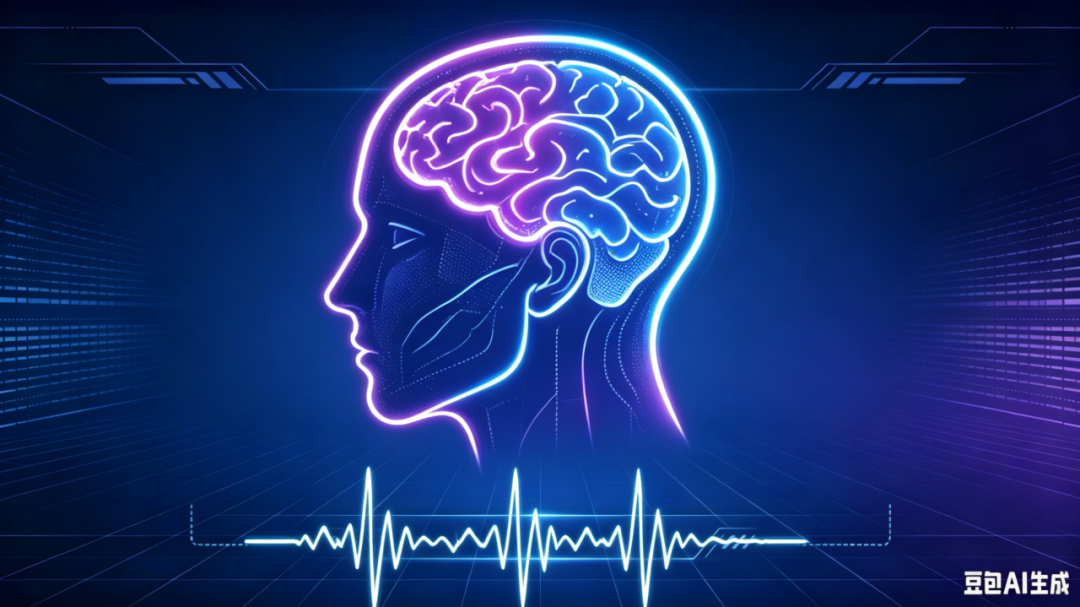
▲Illustration: Conceptual diagram of electroencephalography (EEG)
Electroencephalography (EEG) signals are extremely subtle, yet they contain a wealth of information. They may be associated with emotional changes, help reveal how the brain processes semantics, and potentially support future applications such as brain-computer interfaces, intelligent rehabilitation, and human-machine interaction. However, enabling machines to truly understand EEG signals remains challenging. Significant variations exist across individuals, scenarios, and tasks, making it difficult for traditional models to generalize effectively.
Recently, the results of Shanghai Jiao Tong University's Outstanding Bachelor's Thesis Awards for the Class of 2026 were announced. Junyu Pan, an undergraduate student from SJTU Paris Elite Institute of Technology (SPEIT), received this prestigious distinction for his graduation thesis entitled EEG Emotion, Semantic and Visual Decoding Based on Multimodal Large Models. Only 1% of graduating students receive this honor.

▲Photo: Commencement Ceremony for the SJTU Class of 2026
Upon hearing the news, Pan was delighted.
For him, the award represented more than the completion of a thesis—it was the culmination of four years of research training during his undergraduate studies.
From his first visit to the Brain-like Computing and Machine Intelligence Research Center (BCMI) at Shanghai Jiao Tong University during the summer after his freshman year, where he was first introduced to EEG-related research, to his later internship at Microsoft Research Asia, where he further refined his research focus, Pan gradually transformed countless hours of literature review, experiment reproduction, research redirection, and manuscript revision into this award-winning thesis.
From EEG Signals to Multimodal Large Models
Junyu Pan graduated from Wenzhou Yuying International Experimental School. During high school, he received rigorous mathematical training and participated extensively in mathematics competitions. After enrolling at SPEIT, he chose Information Engineering, a discipline closely related to mathematics. As his coursework and research experience deepened, his academic interests gradually became more focused.
The question that captured his attention can be summarized simply: can multimodal large models help AI better understand EEG signals?
In his undergraduate thesis, Pan explored how EEG signals can be connected with images and language. His research investigated the possibility of mapping EEG signals into a unified visual and linguistic semantic space, enabling models to perform a variety of tasks, including emotion recognition, semantic understanding, and visual reconstruction.
According to Pan, such research may eventually contribute to applications including depression diagnosis, epilepsy detection, and exoskeleton control.
Although these topics may sound highly advanced, his journey began in a very ordinary way.
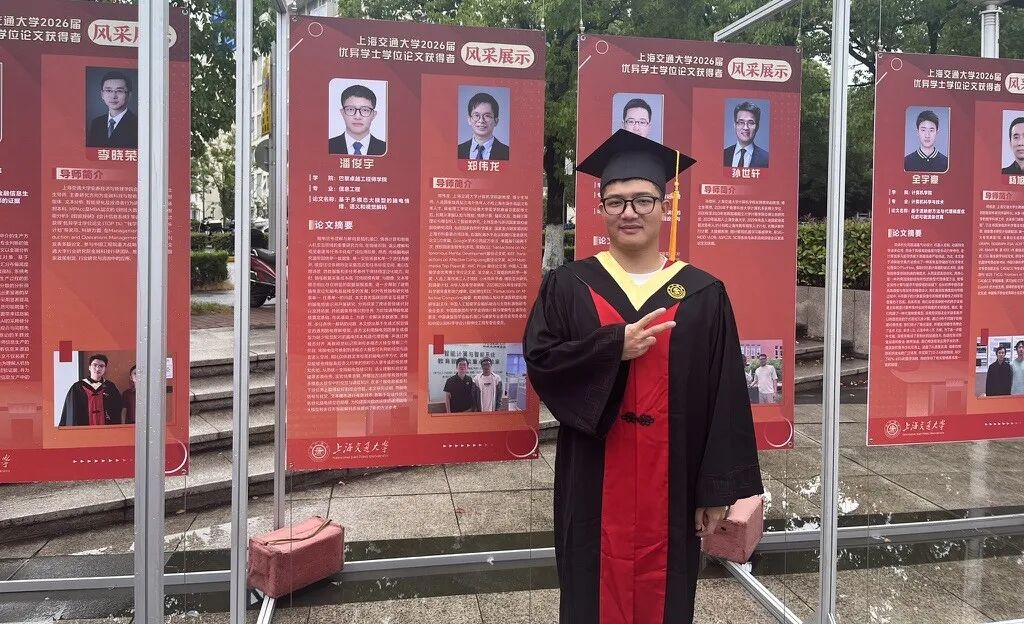
▲Photo: Junyu Pan at the Exhibition of Outstanding Bachelor's Theses for the Class of 2026
First Steps into Research: Entering the Laboratory During His Freshman Summer
Pan's connection with EEG research began during the summer following his first year at university.
Thanks to the abundant research opportunities and strong faculty support provided by SPEIT, he joined the BCMI laboratory and formally began working on EEG-related research for the first time. At the outset, his theoretical knowledge and practical experience were limited. Under the supervision of Associate Professor Weilong Zheng, he started with foundational research tasks: reading academic papers, reproducing experiments, analyzing results, and learning how to write scientific articles.

▲Photo: Junyu Pan with his bachelor's thesis supervisor, Associate Professor Weilong Zheng
His first project focused on cross-scenario emotion recognition based on EEG signals.
Looking back, he considers the project relatively fundamental, yet extremely important. It was through this experience that he learned the complete research process: identifying problems, designing experiments, analyzing results, and transforming ideas into academic publications.
As his experience accumulated, he gradually became capable of conducting research independently and developed his own scientific judgment.
During the summer of his sophomore year, Pan completed his first industry internship. The experience helped him realize that he was better suited to research-oriented work than to purely engineering-focused positions.
A turning point came while reading cutting-edge research papers. He discovered that one particularly impressive paper had been co-authored by a senior student from his laboratory during an internship at Microsoft Research Asia. Coincidentally, he later learned that one of his former high school classmates was also interning there. With the support of his academic advisor, Pan obtained an internal referral opportunity. After several rounds of interviews, he successfully joined Microsoft Research Asia.
It was during this period that he gained exposure to broader research perspectives and more advanced scientific challenges. His research gradually expanded from relatively specialized EEG emotion recognition to the development of general EEG foundation models capable of handling multiple scenarios and tasks.
Under the joint supervision of Associate Professor Weilong Zheng from Shanghai Jiao Tong University and Researcher Yansen Wang from Microsoft Research Asia, he continuously refined his research questions and ultimately focused his bachelor's thesis on the development of a unified EEG large model integrating both understanding and generation capabilities.
Rapid AI Development Requires Constant Reconsideration of Research Questions
“Has the rapid development of AI influenced your research?”
Pan's answer is unequivocal: yes. However, he emphasizes that the influence is bidirectional.
Artificial intelligence evolves at an extraordinary pace. New technologies, models, and research papers emerge continuously. For undergraduate researchers, the challenge is not only to keep up with developments but also to constantly evaluate whether their research questions remain important, whether their methods still have value, and whether their research directions should be adjusted.
Throughout the thesis-writing process, Pan repeatedly reviewed the latest literature and maintained frequent discussions with both academic and industry mentors. Their guidance helped him gradually clarify his research framework and sharpen the focus of his thesis.
AI tools themselves also became part of his workflow.
He acknowledges that AI-assisted tools significantly improved efficiency in literature organization and drafting initial manuscripts. Nevertheless, completing a rigorous academic paper still requires logical reasoning, robust experimental evidence, and repeated revision.
“Academic writing is not merely about language expression; it also requires rigorous argumentation,” he explains. To complete the thesis, he carefully reviewed every section, verified experimental results and conclusions, and revised the manuscript word by word.
Building a Strong Foundation at SPEIT
As an Information Engineering student at SPEIT, Pan spent the early years of his undergraduate studies immersed in extensive training in mathematics and the physical sciences.。These experiences gradually strengthened his ability to confront unfamiliar problems, decompose complex challenges, and persist in finding solutions.
He admits that he initially felt considerable pressure after entering the Institute. The curriculum was demanding, with substantial requirements in both mathematics and French. Like many students newly graduated from high school, he felt uncertain about his future while facing a wide range of opportunities and choices.
The turning point came when he decided to join a research laboratory simply to give it a try.He discovered that focusing deeply on meaningful work helped alleviate much of his anxiety.

▲Photo: A classroom at SPEIT
In his view, SPEIT's integrated bachelor's-master's training model provides students with exceptional freedom to explore their interests. While fulfilling academic requirements, students can engage in laboratory research or industry internships without worrying about immediate postgraduate admission decisions, allowing them to explore both scientific research and industrial practice.
His internship at Microsoft Research Asia was also highly flexible, enabling remote participation and helping him balance academic coursework with research activities.
Research Is Never a Smooth Journey
During his undergraduate years, Pan experienced paper rejections, research redirections, and experimental setbacks. At first, rejected submissions were discouraging. Over time, however, he learned to maintain a healthier perspective.
“Conference acceptance can involve a certain degree of randomness. The most important thing is to stay calm,” he says.
The statement may sound simple, but behind it lies a sense of resilience developed through years of research training—a recognition that setbacks are normal and that what truly matters is continuing to move forward and think critically.

▲Photo: SPEIT's laboratory building and the Institute's new building currently under construction
After graduation, Pan will continue directly into graduate studies at SPEIT while pursuing further research at BCMI. His future work will focus on general EEG foundation models and their applications.
In his view, large models trained on massive datasets have already demonstrated remarkable representational capabilities. Inspired by this success, the EEG community has begun developing foundation models specifically designed for brain signals. However, EEG datasets remain far smaller than text and image datasets, limiting further improvements in model performance.
Consequently, integrating EEG representations into richer visual and linguistic semantic spaces through multimodal large models may become a key direction for future research on unified EEG understanding and generation.

Four years ago, Pan never imagined that he would receive such recognition upon completing his undergraduate studies.
His story illustrates that engaging with cutting-edge research does not necessarily begin with a grand ambition.
Many forms of growth occur quietly, without attracting immediate attention.
Research at the intersection of artificial intelligence and brain science continues to evolve rapidly.
As one chapter closes with graduation, Junyu Pan is already preparing for the next stage of his journey.
策划|宣传与招生办
来源|本科生教务办
文|根据访谈整理
图|潘俊宇、李军艳等提供
责编|周向雨