










Recently, the PandaX Collaboration led by Shanghai Jiao Tong University has achieved important progress in the experimental investigation of neutrino and dark matter self-interactions. Using xenon-136 double beta decay data collected by the PandaX-4T liquid xenon detector, the collaboration imposed direct experimental constraints on neutrino self-interactions mediated by light scalar particles, attaining the world’s tightest experimental limits in the mass range of 0.8–2 MeV. The relevant findings, titled Probing Scalar-Neutrino and Scalar-Dark-Matter Interactions with PandaX-4T, have been published in Physical Review Letters (PRL), a top-tier journal in physics. SJTU serves as the primary affiliation of this work.
Li Tao, research assistant at SJTU Paris Elite Institute of Technology (SPEIT), is the first author of this paper. He was responsible for experimental data analysis, including event reconstruction, signal and background modeling, energy spectrum fitting and statistical inference. Distinguished Professor Michael Ramsey-Musolf, Van Que Tran (alumni), and 2022 PhD candidate Yihong Zhong from the Tsung-Dao Lee Institute are the co-authors. Liu Jianglai, joint professor affiliated with both the Tsung-Dao Lee Institute and the School of Physics and Astronomy, serves as the Chief Scientist of the PandaX experiment.
This achievement fully demonstrates the great potential of PandaX double-beta decay research for probing the early Universe, fundamental properties of neutrinos and dark matter, as well as the broader field of physics beyond the Standard Model.
Link to the original paper:
RESEARCH BACKGROUND
In two-neutrino double-beta decay, two neutrons inside an atomic nucleus simultaneously convert into two protons, emitting two electrons and two antineutrinos. Since neutrinos lose almost no energy within the detector, experiments primarily measure the total energy spectrum of the two electrons. If neutrinos are Majorana particles, the two final-state antineutrinos will annihilate each other, meaning the total energy of the two electrons measured experimentally is expected to take a fixed discrete value.
This study proposes a new light scalar particle ϕ that couples to neutrinos, which may lead to the additional emission of the particle ϕ in the final state of the decay. This particle may either escape the detector or decay into invisible particles, producing spectral distortions featuring missing energy in the energy spectrum.
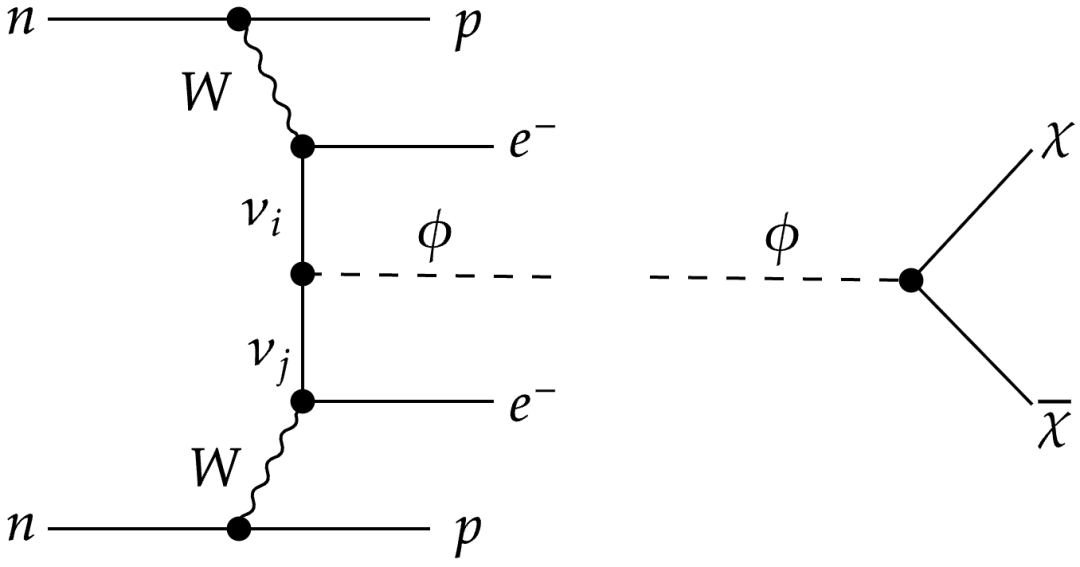
▲ Feynman diagram illustrating the emission of a scalar particle during double-beta decay.
This scalar particle may decay into two dark matter particles.
METHODS AND RESULTS
The research team constructed a real scalar particle model, in which the scalar particle couples to both neutrinos and dark matter. It can not only induce scalar particle emission in double-beta decay, but also generate neutrino self-interactions, dark matter self-interactions, and interactions between neutrinos and dark matter.
By calculating the phase-space factors and nuclear matrix elements for double-beta decay with scalar particle emission, the team searched for the corresponding distortions in the electron energy spectrum using xenon 136 double-beta decay data from the PandaX 4T experiment. Experimental constraints on the neutrino scalar coupling constant gνϕ were derived at the 90% confidence level. Notably, within the mass range of 0.8–2 MeV, these experimental limits constitute the tightest laboratory bounds reported worldwide to date.
Theoretical physicists have previously proposed that neutrino self-interactions could resolve the much-discussed Hubble tension — the discrepancy between measurements of the Hubble constant obtained from the early and late Universe. If neutrino self-interactions arise from the exchange of a scalar particle, the PandaX results definitively rule out this scenario for scalar masses below 2 MeV.
Furthermore, if the scalar participates in dark matter self-interactions, the neutrino scalar and dark matter scalar couplings together generate neutrino–dark matter scattering. Such scattering modifies the evolution of small-scale fluctuations in the early Universe and is subject to observational limits from the cosmic microwave background and matter power spectrum.
The research team combined the constraints from PandaX-4T with cosmological observation to place tight experimental bounds on the dark matter–scalar coupling constant gχϕ. This work provides brand-new experimental bounds linking together double-beta decay, the Hubble tension, dark matter self-interactions and the evolution of the early Universe.
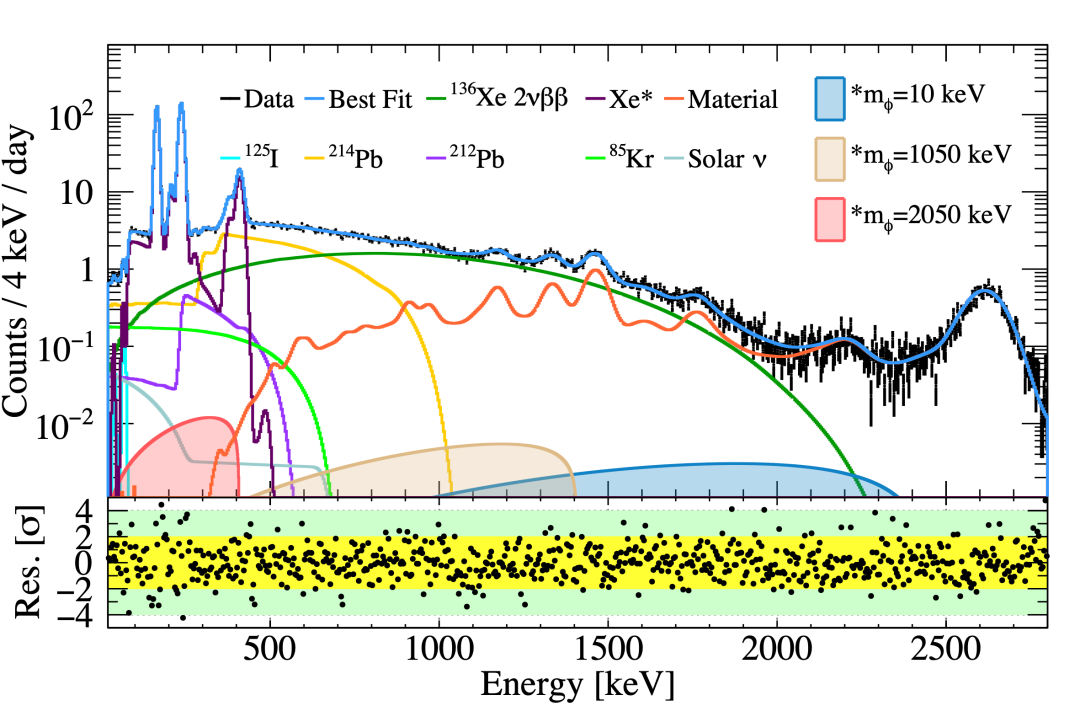
▲ Spectral fit results of data from the PandaX-4T experiment

▲ Experimental constraints on the neutrino–scalar coupling constant gνϕ from the PandaX-4T experiment, achieving the world’s tightest limits in the mass range of 0.8–2 MeV.
The PandaX Collaboration is a joint research team initiated and led by SJTU, dedicated to searching for dark matter and investigating cutting-edge physical topics such as neutrinos at the China Jinping Underground Laboratory. Its partner institutions include Shandong University, Peking University, University of Science and Technology of China, Sun Yat-sen University, Beihang University, Nankai University, Fudan University, the China Institute of Atomic Energy, and Yalong River Hydropower Development Company, Ltd. (Yalong Hydropower), among others.
The PandaX research group from SPEIT is one of the key participating teams within the PandaX Collaboration. Its members include Associate Professor Wang Shaobo, Research Assistant Li Tao, and master’s degree candidates Huang Houqi, Yao Shunyu, Zhou Jiaxu, Qiu Xiaosheng, Jing Zhan, Yu Haosong, Yang Peiqi, among others. The group undertakes work covering experimental data analysis, machine learning algorithm development, Monte Carlo simulation, and the photoelectric readout system for the PandaX experiment.
This work received extensive support from the China Jinping Underground Laboratory, and financial funding from the National Natural Science Foundation of China, the Ministry of Science and Technology of China, the New Cornerstone Science Foundation, the Yangyang Development Fund, the Shanghai Municipal Science and Technology Commission, the China Postdoctoral Science Foundation, and the Hong Kong Hongwen Foundation.
For now, the PandaX project is actively advancing the research, development and construction of the next-generation tens-of-tonne liquid xenon detector, helping China’s major scientific facilities sustain an internationally leading position in dark matter and neutrino research.