







EDUCATION — Education and Training

The entrances of Lycée Louis-le-Grand and Lycée Henri-IV
If the visit to IHES was a relaxed scientific exploration in the woods, the immersive experience at two French preparatory schools unfolded in an entirely different atmosphere and rhythm.
In Paris's Latin Quarter stands two elite schools, each with several centuries of history: Lycée Louis-le-Grand (LLG) and Lycée Henri-IV. Both have long-established secondary-school divisions as well as some of France's most prestigious “classes préparatoires aux grandes écoles” (CPGE).
Over the centuries, many leading figures in science and thought studied here, from Molière, Voltaire and Galois to Sartre, Foucault and the Nobel laureate in Economic Sciences, Esther Duflo.
Today, these schools still attract some of the brightest young minds in France. In France, students aspiring to enter an elite engineering grande école must, after passing the baccalauréat, complete two years of intensive training in mathematics and science in a CPGE, then pass highly competitive entrance examinations (concours) before continuing their studies at an engineering school. They therefore face competition every bit as intense as China's national college entrance examination, the gaokao.
The students of the 2025 Descartes Class at the SJTU Paris Elite Institute of Technology (SPEIT) are in the second year of a 6.5-year Sino-French integrated bachelor's and master's programme for elite engineers, at the same stage of study as their French peers in CPGE.

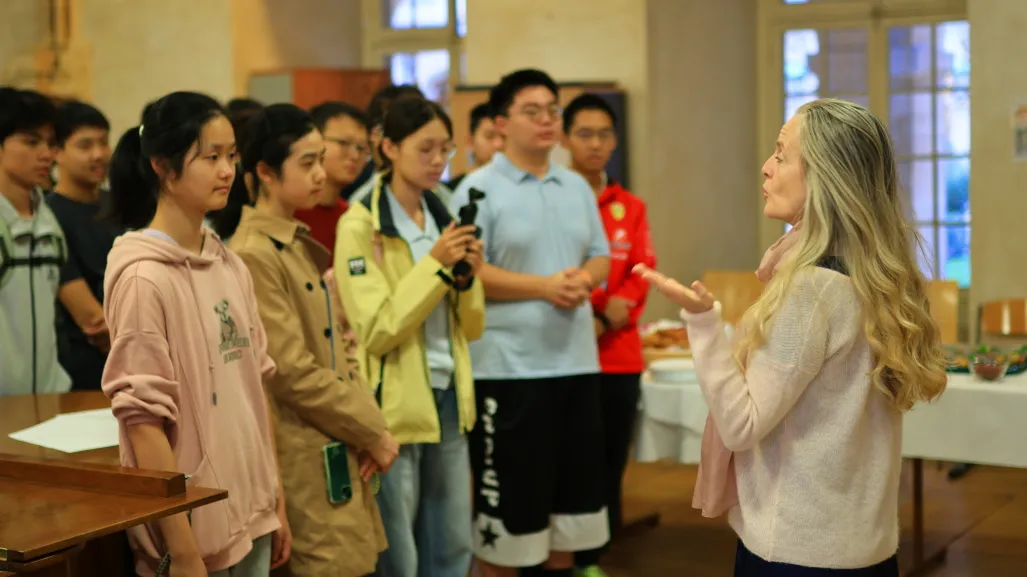
At the welcome ceremonies at Lycée Louis-le-Grand (top) and Lycée Henri-IV (bottom).
During the final two weeks of their study visit in Paris, the students attended both schools in groups, joining CPGE classes alongside French peers and gaining first-hand experience of the foundational training underpinning France's elite engineering education.

FOUR HOURS AT THE BLACKBOARD
QUATRE HEURES AU TABLEAU
In French preparatory classes, subjects such as maths and physics hold a central place.
The Descartes Class students joined different tracks, including MP (mathematics and physics), PC (physics and chemistry), and MPSI (mathematics, physics and engineering sciences). Each track had its own emphasis, but everyone agreed that the pace was fast, the material demanding, and the expectations for mathematical and scientific foundations and logical reasoning exceptionally high.
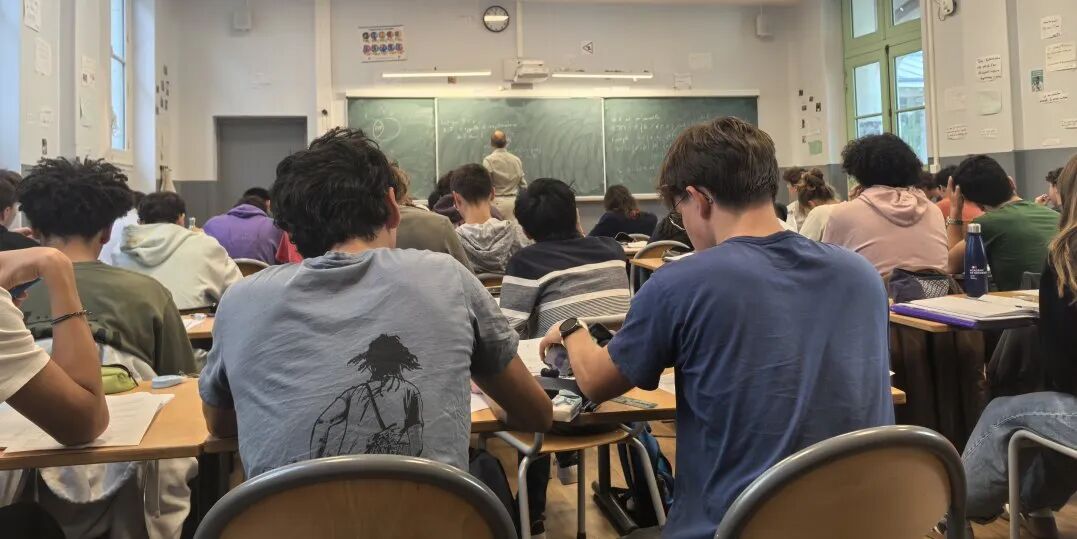

Liu Liming noted that mathematics classes often ran from 8 a.m. to noon, with only a short break. When something was unclear, French students raised their hands and asked questions on the spot. Teachers also frequently invited students to the board to present their solutions.
Another scene stayed with Professor Kong Sijia, who was accompanying the group: the moment the teacher posed a question, hands shot up across the room. At times, so many students wanted to answer that the teacher had to look around for several seconds before deciding whom to call on.
Here, intensive training goes hand in hand with a strong enthusiasm for learning.
Du Ruizhou observed that French preparatory education was distinctly exam-oriented. With the highly competitive concours in view, classes included extensive, rigorous training geared towards the entrance examinations; even so, the enthusiasm and sustained engagement of his French peers exceeded his expectations.
"Their enthusiasm for learning was far greater than I had expected."

By the end of the week, the students had developed a more concrete understanding of French preparatory education. Far from the exam-free, open classroom they had imagined, it was a clearly focused and highly demanding system of training.
At Henri-IV, the group also met Valentin Vinoles, who previously taught at SPEIT and now teaches maths at Henri-IV, prepared an engaging lesson tailored to the Descartes Class students' existing knowledge.


“How fast does a seemingly simple recursive sequence grow as the number of terms increases?”
Starting from this question, Valentin introduced an elegant mathematical way of thinking: drawing an analogy between the discrete and the continuous. He linked the difference between consecutive terms of a sequence to the derivative of a continuous function, used a differential equation to identify a pattern, and then returned to the sequence to verify the initial conjecture through rigorous derivation.
From familiar sequences, limits and sums to asymptotic analysis, which the students had not yet studied systematically, Valentin connected their existing knowledge naturally with new mathematical methods.
They discovered that mathematical problems that appear different can, from a new perspective, be connected.

MINI SCIENTIFIC PROJECTS
MINI-PROJETS SCIENTIFIQUES
After a packed week of mathematics and science at LLG, the training took a different form.
Six Groups, Six Mini Projects.
Fouad Lahmidani, the school's international relations coordinator and a physics teacher, designed six topics specifically for the students to investigate real physical phenomena.
Some observed the motion of a long spring in free fall; others studied the relationship between the volume of water in a glass bottle and its resonant frequency. Other groups explored wing lift and the Magnus effect, resonance and vibration damping in high-rise buildings, the coefficient of friction of a non-smooth surface, and the vibration patterns of a string driven by a mechanical exciter.
They built the apparatus themselves, took their own measurements, and worked out their own explanations.
From designing the experiment and assembling the apparatus to observing phenomena, developing mathematical models and analysing results, the students had to apply what they had learned in class to the problems before them, and present their projects in French.

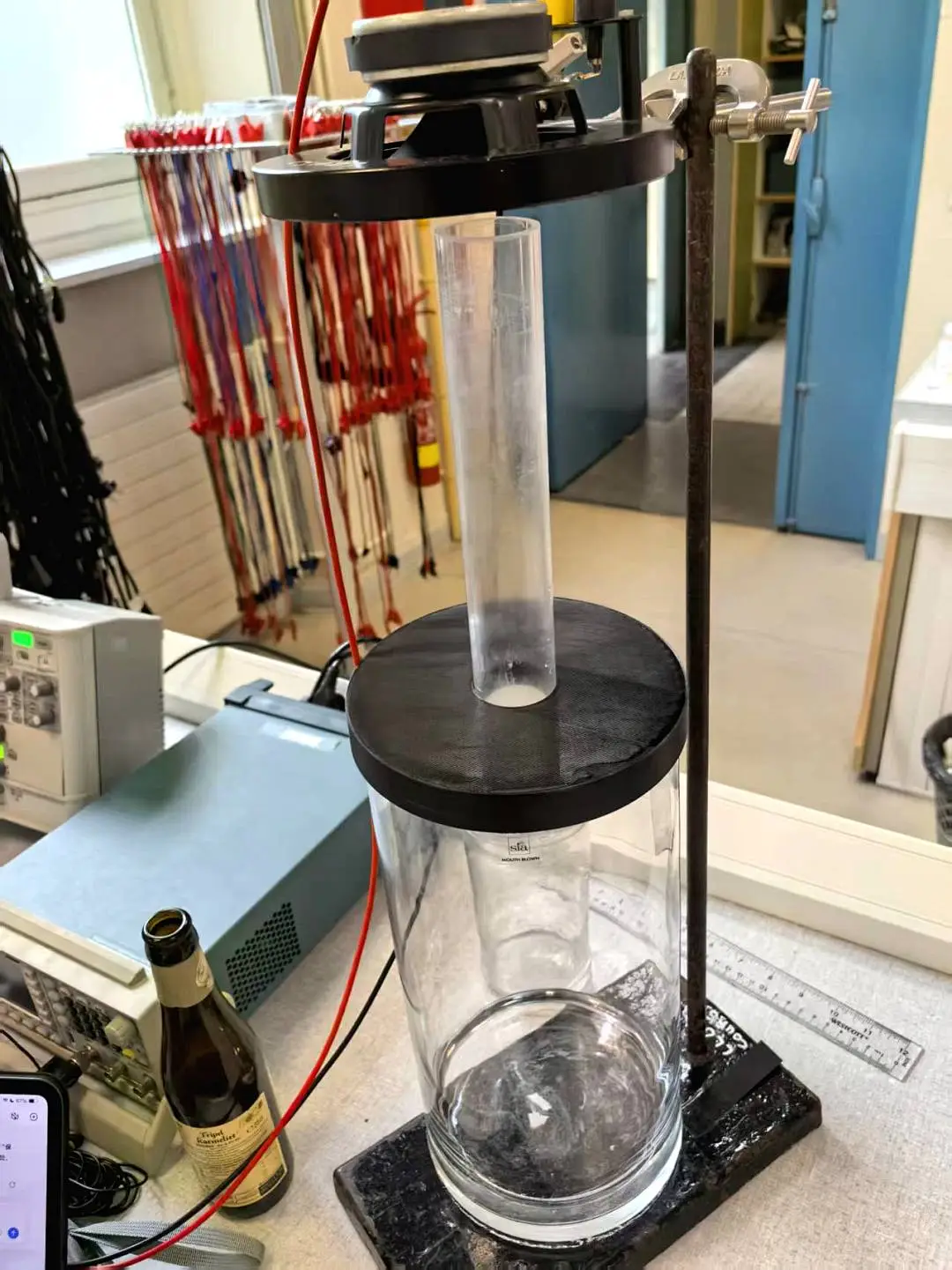

A simple experimental setup built by students using the equipment available in the university laboratory.
This form of research closely resembled the TIPE (Travaux d'initiative personnelle encadrés, or supervised personal initiative projects) undertaken in the French preparatory system. TIPE work centres on independent investigation of a specific scientific question and uses experimentation, modelling and presentation to develop the ability to identify, analyse and solve problems.
The work of all six groups earned Lahmidani's approval, and he offered specific suggestions for improving their experimental design and research methods.
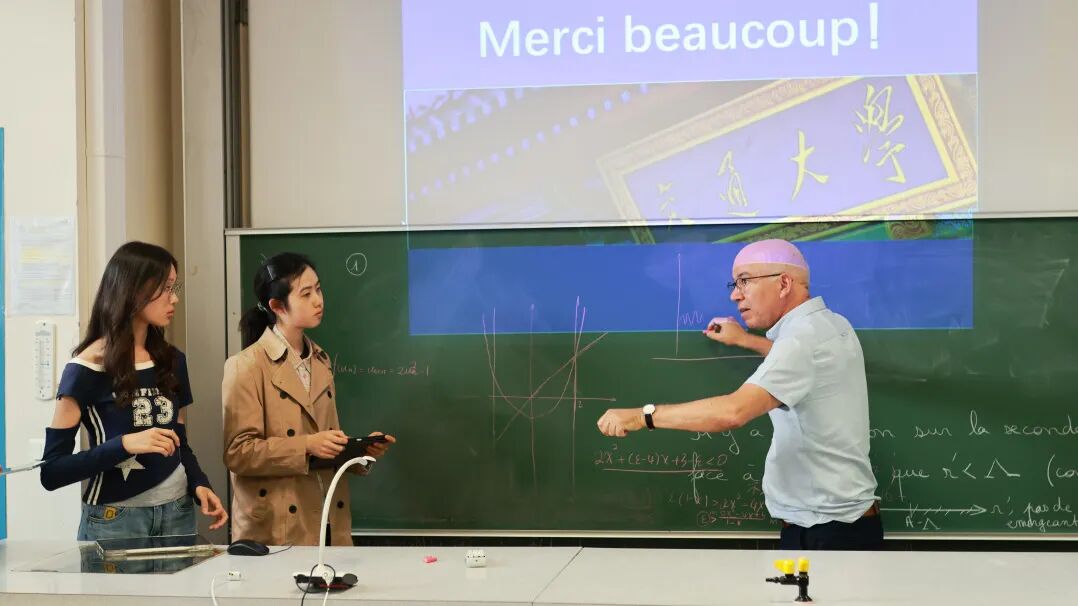
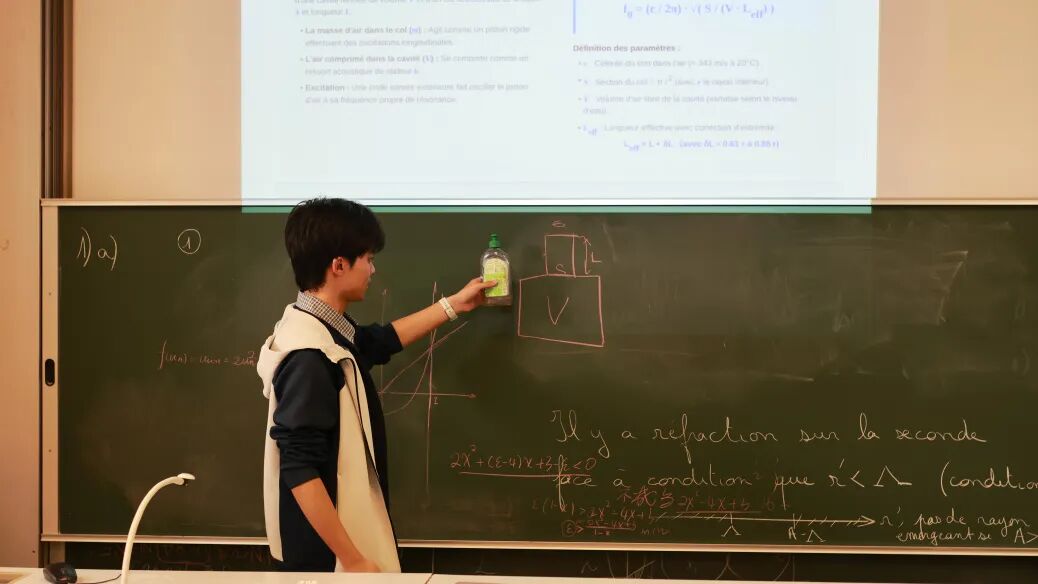


Professor Shi Qiwei, who was accompanying the group, greatly appreciated this approach. In his view, what matters is not whether the equipment is expensive or specialized. The truly valuable scientific and engineering training lies in starting from a question, building an experimental setup independently with available equipment, working hands-on to find explanations, and testing ideas and uncovering scientific insights through repeated trials.
These hand-built devices found echoes of the past in LLG's science museum. The museum displays scientific instruments and teaching apparatus from different periods, many of them likewise made by teachers.


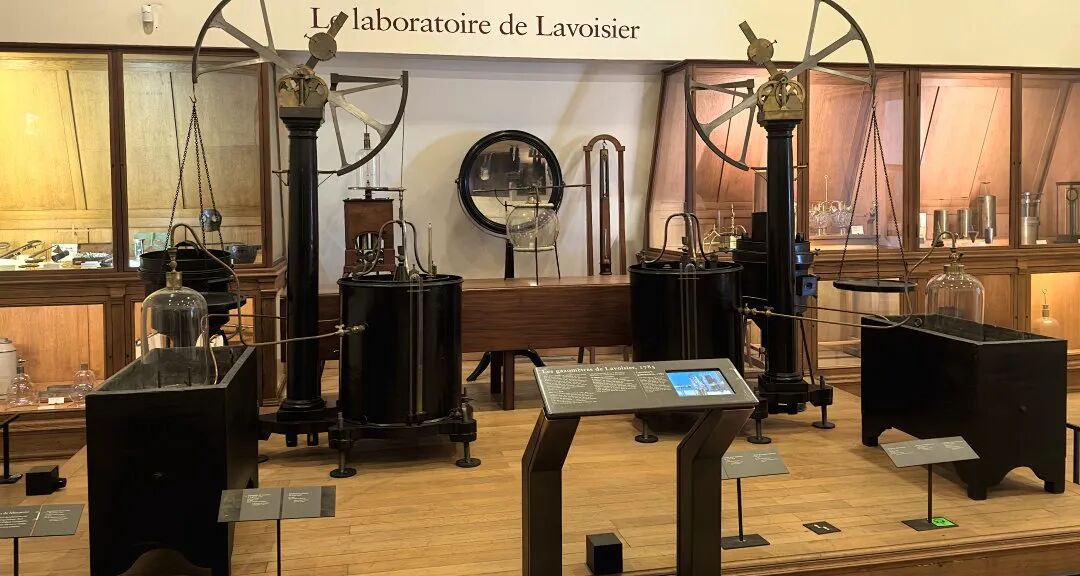
Sylvie Dancre, a retired physics teacher in her eighties, warmly explained how the instruments were used and drew on several exhibits to share ideas about energy conservation.

BEYOND MATHEMATICS AND PHYSICS
AU-DELÀ DES MATHS ET DE LA PHYSIQUE
Within LLG's massive stone walls and courtyards, a rigorous academic tradition endures. Henri-IV retains the architectural character of the former Abbey of Sainte-Geneviève, and from its ancient cloisters and gardens, the dome of the nearby Panthéon is visible.


The traditions of science and the humanities are woven into everyday school life.
At the preparatory schools, students could devote part of their time to elective classes.
At LLG, He Qirong and Liu Liming chose to sit in on a philosophy class. Rousseau and Kant came up repeatedly; the teacher began with the meaning and evolution of the French word génie, selected passages from philosophical classics, and guided the discussion.
"The philosophy class was highly thought-provoking. Starting from a word, tracing a concept and distinguishing shades of meaning felt somewhat like the traditional Chinese practice of analyzing the forms and meanings of characters."
Of course, following a philosophy class in French was not easy. "I had a little trouble following towards the end." He Qirong admitted.
Du Ruizhou chose instead to attend a class in Engineering Sciences (Sciences industrielles). Starting from practical problems, the course used mathematics and physics to model, analyze and solve them.
"The core of the course is modelling and solving real-world problems, which is excellent training in mathematical and physical modelling." Du Ruizhou found this integrated use of knowledge fascinating and gained considerable inspiration from it.
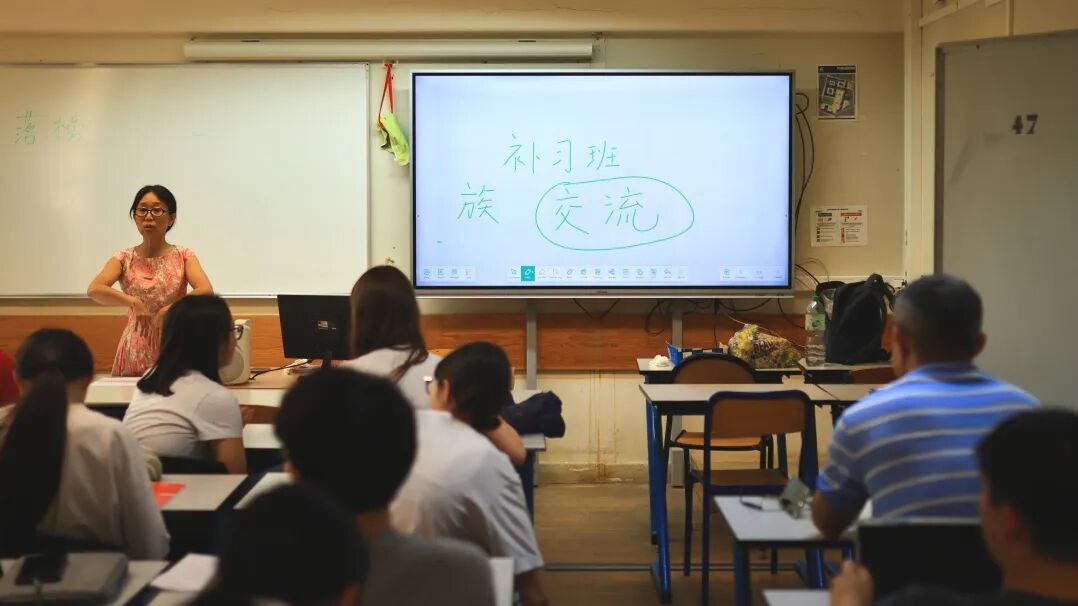
A Chinese class at Henri-IV
At Henri-IV, the group also joined a Chinese class attended by French students.
French preparatory education is not limited to mathematics and science; foreign languages are also part of the curriculum. Some students choose Spanish or German, while others choose Chinese.
What is the difference between yòu ("again") and hái ("also" or "still")? When should one use zhuānxīn ("to concentrate"), rènzhēn ("conscientious") and yòngxīn ("attentive")? Expressions that come naturally to native speakers became questions requiring careful distinction in the Chinese classroom. Hearing the French students' pronunciation and phrasing reminded the group of their own early experiences of learning French.
A different language and a different perspective revealed that the same familiar difficulties and amusing moments arise for others too.


Beyond the classroom, the historic campus itself offered a lesson worth taking time to absorb. At Henri-IV, Bruno Michel, the head librarian, who was nearing retirement, devoted a full day to guiding the group through the campus and its history and culture.
From the old school buildings to the surrounding streets of the Latin Quarter, the Panthéon and other historic sites, he described along the way how the school and the city of Paris had changed over time.
EXCHANGES BETWEEN FRENCH AND CHINESE STUDENTS
ÉCHANGES ENTRE JEUNES FRANÇAIS ET CHINOIS
Beyond the classroom, exchanges between the French and Chinese students developed naturally.
"Why did you come to France?" "What are your classes usually like?" "Do you use AI when you study?"


The students of the Descartes Class are chatting with French students during the break.
From curricula and routes into higher education to food, entertainment and cultural differences, they always found new topics to discuss.
Even when their language skills are still developing, communication comes naturally.
Yu Yihan wrote, “Although my French is not yet fluent, the French students and I could still understand one another.”
During breaks, Du Ruizhou also noticed that the French students generally had a strong musical grounding. In the common room, a student would often sit down at the piano and effortlessly play a beautiful melody.
At the final farewell event, a French student approached the Descartes Class students and teachers to ask, “How can I come to SPEIT on exchange?”
The free and open academic discussions at IHES and the intensive mathematics and science classes in the preparatory schools showed the students both the heights that scientific research can reach and, first-hand, the foundations, passion and commitment required to pursue more ambitious goals.
From the woods of IHES to the blackboards of the Latin Quarter and back to the SJTU campus, the students broadened their horizons through experience and comparison, gradually developing their own approaches to learning and their goals for the future.
The Descartes Class students' journey of exploration continues.
文/周向雨 图 /刘力铭、喻毅涵、毛昱欢、施奇伟、
孔思佳、杜汭舟 等提供 排版 / 程照